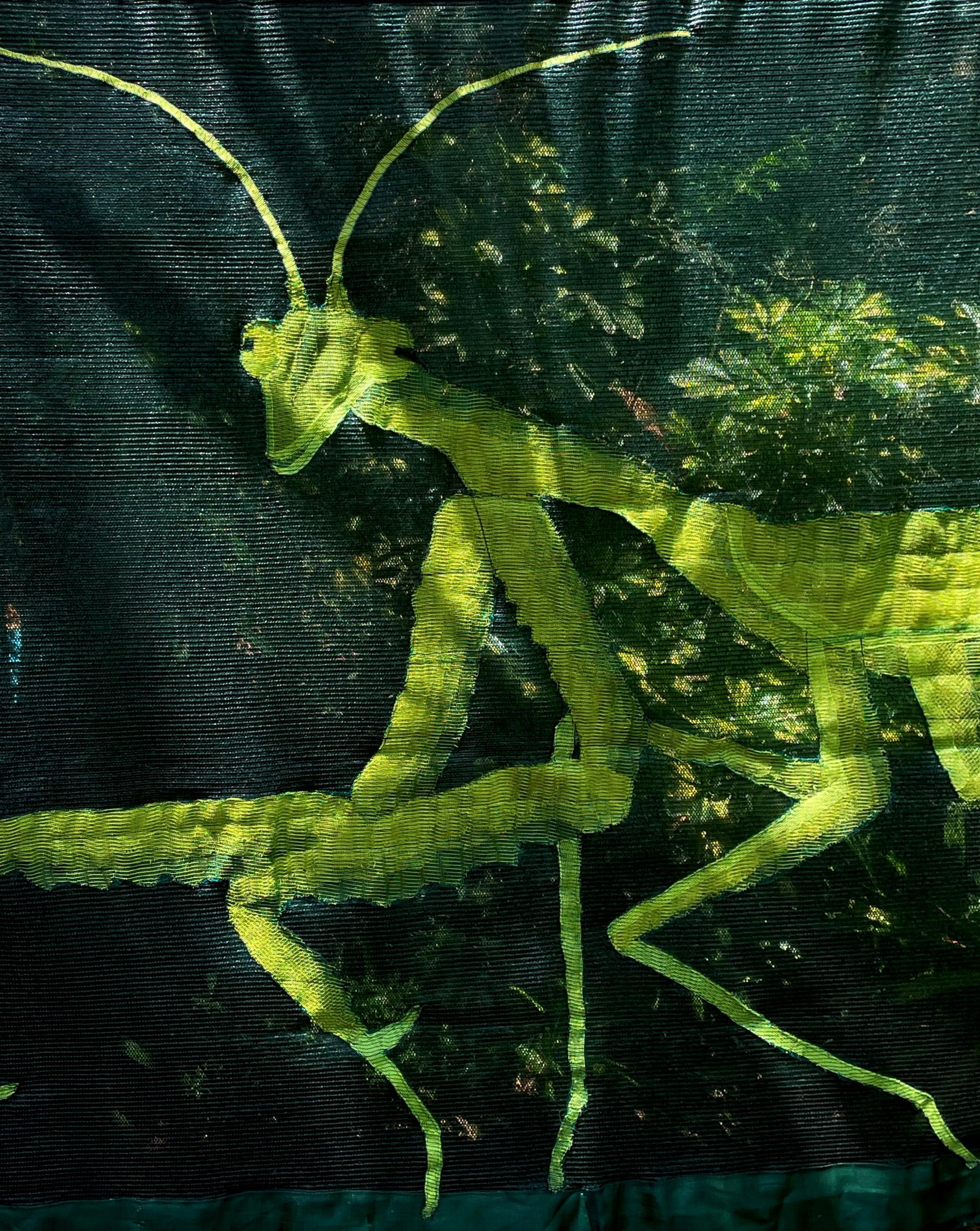
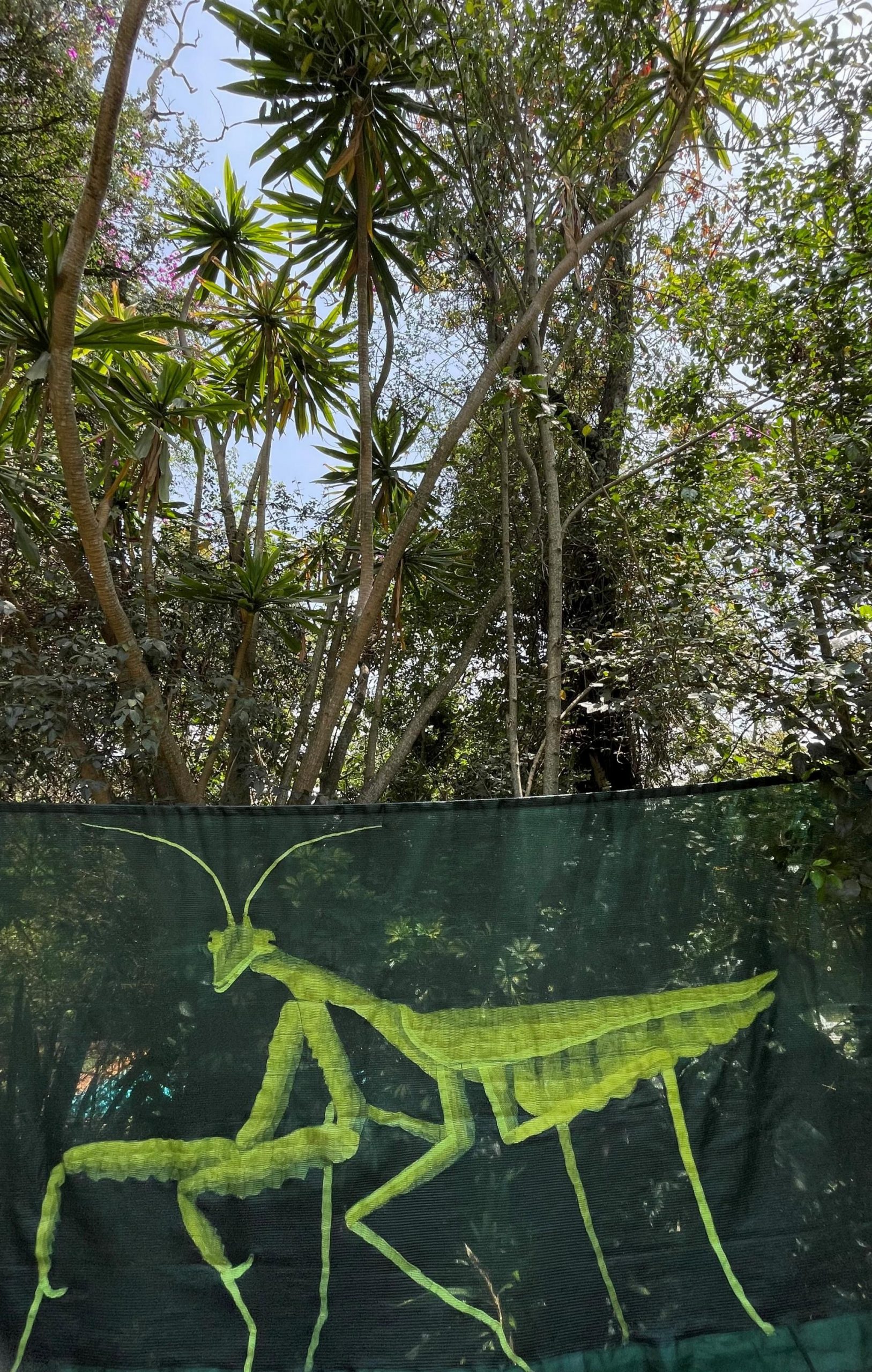
Starting in October 2026, two new works by Italian artist Hilario Isola will become part of the spaces of the Embassy of Italy in Nairobi and the Ambassador’s Residence: Palpares libelluloides, installed in the garden of the Residence, and Sphodromantis viridis, initially installed in the same garden and subsequently destined for the entrance of the Embassy.
The two works are part of a site-specific installation project that brings contemporary art, nature and architecture into dialogue. Inspired by African ecosystems, the sculptures use materials associated with agricultural technology and transform them into organic forms that integrate into the landscape and engage with the context of the diplomatic premises.
The works are created by cutting, assembling and hand-stitching hail protection nets in different colours. The overlapping layers create effects of transparency, light and shadow, giving shape to works that exist between the natural and the artificial.
The project reflects on biodiversity and the need to preserve insects as a vital resource and as key protagonists of ecosystems, while also highlighting the value of crop diversification and more sustainable agricultural practices in a context marked by significant climatic and environmental transformations.
Palpares libelluloides
Palpares libelluloides is a large insect belonging to the Myrmeleontidae family. Its broad wings may resemble those of a dragonfly, although it belongs to a completely different order.
In Isola’s work, the insect is enlarged and transformed into a presence that is both light and monumental. Integrated into the garden of the Ambassador’s Residence, the sculpture interacts with the vegetation and the garden architecture, creating a dialogue between the forms and colours of the insect and the African landscape.
Its presence invites us to pay greater attention to a part of biodiversity that often remains unseen or is considered marginal, reminding us of the fundamental role insects play in maintaining natural ecosystems.
Sphodromantis viridis
The name mantis derives from the Greek mántis, meaning “prophet”, and refers to the characteristic posture of the insect, which has long been observed with a combination of respect and apprehension.
Sphodromantis viridis, commonly known as the African mantis, is a species found in various parts of Africa and is now also present in southern Europe. A predator, it is characterised by its distinctive raptorial forelegs, which it uses to capture its prey.
In Isola’s work, the mantis is enlarged to become a sculptural presence capable of transforming the perception of the surrounding space. Initially installed in the garden of the Ambassador’s Residence, the work will subsequently be placed at the entrance of the Embassy of Italy in Nairobi, where it will enter into dialogue with the architecture of the diplomatic premises and the urban landscape.
The choice of the mantis, like that of Palpares libelluloides, evokes the themes of biodiversity and diversification, inviting reflection on the relationship between the environment, agriculture and craftsmanship.
Art, Nature and Italian Craftsmanship
The project stems from a desire to highlight, through contemporary art, the Italian ability to transform materials, technologies and craftsmanship into new forms of artistic expression.
The nets used in the works, produced through industrial processes, are reinterpreted by the artist through a patient process of manual work. A functional material, normally used to protect crops, thus becomes an artistic medium and takes the form of two large insects.
The installation creates a dialogue between Italy and Kenya, between technology and nature, agricultural production and craftsmanship. Set within the spaces of the Residence and the Embassy, the two works become part of the everyday landscape and invite viewers to look at the relationship between people and the environment with new eyes.
The Artist
Hilario Isola is a visual artist who primarily works with installation, drawing and sculpture. He holds degrees in Art History and Museology and is interested in the history of art, architecture and the environment.
The artist favours the development of delicate, visually light installations capable of engaging with the exhibition space and with the specific geo-cultural context in which they are presented. Processes of perception and transformation are activated through the use of organic materials and sensory references, developing across different scales, from micro-sculptures to large-scale environmental works.
Taking the exhibition and its ritual as subjects in themselves, Hilario Isola has worked to transform the paradigm of this encounter, exploring the possibilities of a dynamic experience. By subtly intervening in nature and reworking it through artificial means, Isola continually finds new ways to emphasise the persistence of biological life, harmonising its elementary manifestations through his artistic practice.
In each work, he reveals the innate sculptural qualities of natural materials and the cultural properties of his subjects, bringing to light deeper patterns of growth and relationships with life and time.
Isola has exhibited his work in Italy and internationally, in prestigious public and private exhibition spaces, including the NMNM Nouveau Musée National de Monaco (Monte Carlo); Art in General, New York; SculptureCenter, New York; the CCA – Canadian Centre for Architecture, Montreal; Museion, Bolzano; the David Roberts Art Foundation, London; Fondazione Bevilacqua la Masa, Venice; Fondazione Sandretto Re Rebaudengo and GAM – Galleria Civica d’Arte Moderna e Contemporanea, Turin.